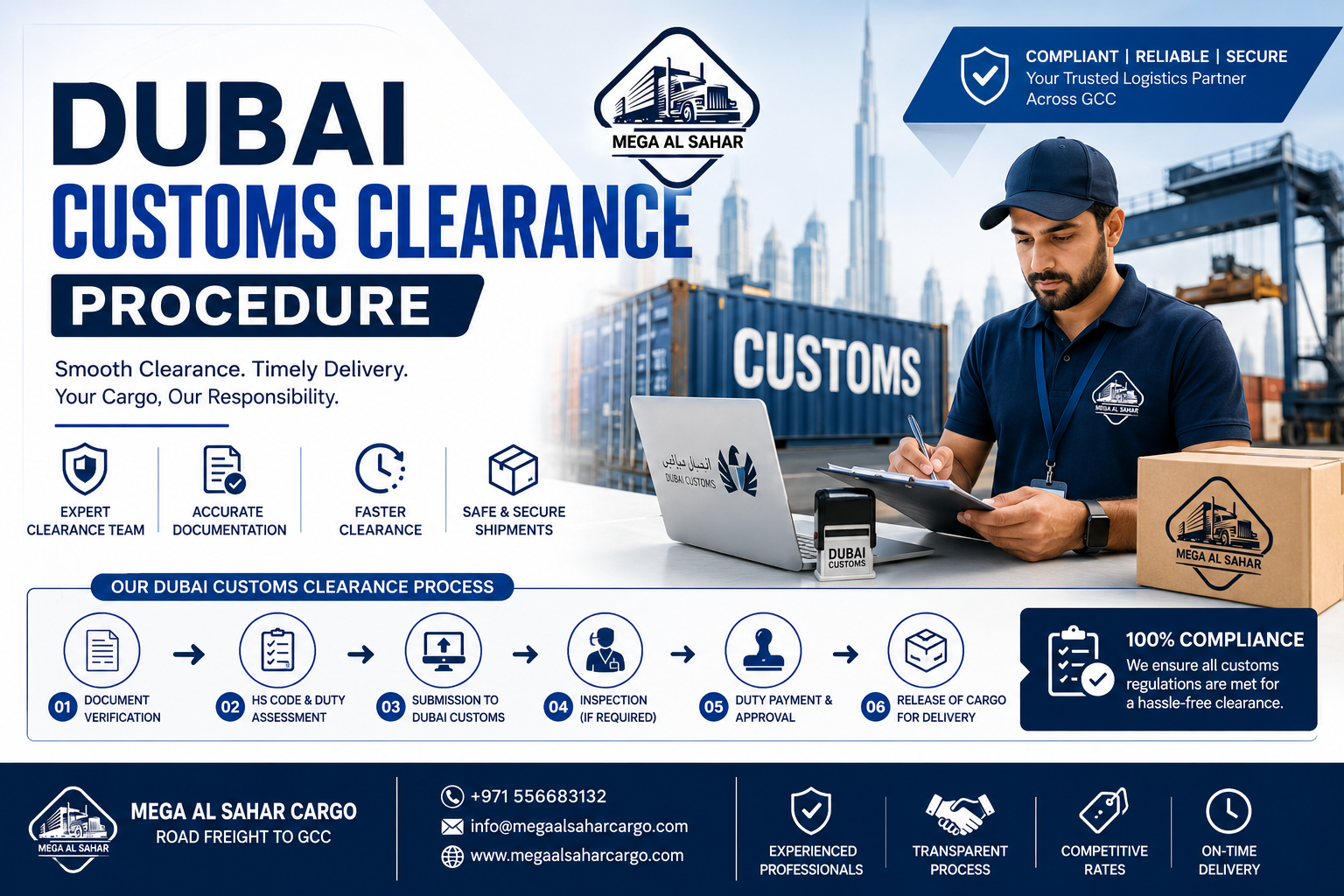
Dubai Customs Clearance Procedure
A Step-by-Step Guide to Importing and Exporting Cargo Through Dubai
What Is the Dubai Customs Clearance Procedure?
The Dubai Customs Clearance Procedure is the official process of registering as an importer or exporter, submitting shipment documentation, declaring goods electronically, paying any applicable customs duty and VAT, and receiving authorization from Dubai Customs before cargo can legally enter or leave the UAE. Every shipment moving through Jebel Ali Port, Port Rashid, Al Maktoum International Airport, or Dubai International Airport must pass through this process before it can be released to the importer, exporter, or onward carrier.
In practice, clearance is handled through the Dubai Trade portal and the underlying Mirsal 2 electronic declaration system, which together allow customs brokers and registered companies to submit declarations, pay duties, and track shipment status without manual paperwork at the port itself. When documentation is accurate and complete, clearance can be completed digitally within hours. When it isn’t, cargo can sit at the port for days, accumulating storage charges the whole time.
This guide walks through the full procedure, the documents you’ll need, current duty and VAT rules, the regulatory changes that took effect in 2026, and where a customs clearance partner like Mega Al Sahar Cargo fits into the process.
Why the Dubai Customs Clearance Procedure Matters
Getting customs clearance right isn’t just a compliance formality — it directly affects your cost, your timeline, and your relationship with customs authorities going forward.
Time — A clean declaration can clear in hours; an incomplete or inconsistent one can hold your cargo for days or weeks.
Cost — Every extra day at the port typically means additional storage and demurrage charges on top of any fines for non-compliance.
Compliance history — Dubai Customs and the Federal Tax Authority (FTA) track compliance patterns. Companies with a clean clearance history tend to face fewer inspections and queries over time; a pattern of errors can lead to closer scrutiny on future shipments.
Legal exposure — Misdeclared value, incorrect classification, or missing permits can result in fines, seized cargo, or in serious cases, legal action against the importer of record.
The Dubai Customs Clearance Procedure: Step by Step
1. Register as an Importer or Exporter
Before your first shipment, your company needs:
A valid UAE trade licence (mainland or free zone) with import/export activities listed
A Customs Client Code, obtained by registering your company on the Dubai Trade portal — this is a one-time setup that issues your unique importer/exporter code
A digital certificate, required to file electronic declarations through the Mirsal 2 system
Without these in place first, your cargo cannot be declared — meaning it sits at the port while registration is completed, which is a common and entirely avoidable source of delay for first-time shippers.
2. Prepare Your Shipment Documentation
Every shipment needs a complete, internally consistent document set before it reaches the port (see the full document list below). The values, quantities, and descriptions on your commercial invoice, packing list, and transport document must all match exactly — even small discrepancies between documents are one of the most common triggers for a customs query or hold.
3. Classify Your Goods with the Correct HS Code
Every product is classified under a Harmonized System (HS) code, which determines the applicable duty rate and whether any permits are required. As of 2026, Dubai Customs requires 12-digit HS codes under the GCC Integrated Customs Tariff — this requirement became mandatory for GCC-destined trade from February 2026 and extends to imports from the rest of the world from August 2026. Businesses still filing under the old 8-digit format are non-compliant and risk classification queries that stall clearance. If you’re unsure how your product should be classified, verify it before filing rather than guessing.
4. File the Customs Declaration
Your customs broker (or your own registered team) files an electronic declaration — sometimes referred to as a Bill of Entry — through the Dubai Trade portal, powered by the Mirsal 2 system. The declaration states the goods, their value, origin, and purpose, and the system automatically checks it against current customs regulations.
Pre-arrival submission is now standard practice, and for sea freight it’s become especially important: since January 2026, sea cargo declarations submitted after the vessel has already arrived can be subject to amendment fines if corrections are needed. Filing before arrival — once your documents are finalized — is the safer approach across the board.
5. Pay Applicable Customs Duty and VAT
Once your declaration is accepted, the system calculates:
Customs duty — standard rate of 5% of the CIF value (Cost + Insurance + Freight) for most goods, with some categories rated differently (see below)
VAT — 5%, calculated on the CIF value plus any customs duty already applied
Duties and VAT are typically payable before release, though VAT-registered businesses can generally reclaim import VAT through their normal VAT return.
6. Inspection (If Selected)
Even with flawless documentation, Dubai Customs reserves the right to physically inspect any shipment. Most cargo with clean, consistent paperwork clears electronically without inspection, but selection can also be random. If your shipment is flagged, having a broker or agent who can represent you during inspection — answering queries and coordinating with the inspecting officer — keeps the process moving rather than stalling on a question that could otherwise be resolved quickly.
7. Release and Delivery
Once duties are paid and any inspection is cleared, Dubai Customs issues a release order, and the cargo is authorized to leave the port or airport for delivery to its final destination — whether that’s a warehouse in the UAE or, for cargo continuing onward, the next leg of a cross-border journey such as road freight into Saudi Arabia or elsewhere in the GCC.
Documents Required for Dubai Customs Clearance
The exact list depends on your cargo type, but most shipments require:
Commercial Invoice — Details the goods, their value, and the buyer/seller; the foundation document customs uses to assess duty.
Packing List — An itemized breakdown of shipment contents, which must match the invoice and physical cargo exactly.
Bill of Lading (sea) or Air Waybill (air) — Issued by the carrier; acts as the transport contract and receipt for the cargo.
Certificate of Origin — Confirms the country where goods were manufactured; required for certain product categories and preferential duty treatment under trade agreements.
Import/Export Declaration — Filed electronically via Mirsal 2 through the Dubai Trade portal.
Trade Licence Copy — Confirms your company is authorized to import or export the relevant goods category.
Import Permit (where applicable) — Required for restricted or regulated goods categories.
Proof of Customs Duty and VAT Payment — Retained for your records and for FTA audit purposes.
Keep digital copies of every document on hand — most delays trace back to a document that’s missing, inconsistent, or produced too slowly once customs asks for it.
Customs Duty and VAT: What You’ll Actually Pay
Standard customs duty is 5% of the CIF value for most goods, under the GCC Common Customs Tariff, with rates for specific categories ranging from 0% up to significantly higher rates for a small number of regulated products (for example, alcohol and tobacco attract much higher duty rates than standard goods).
VAT is charged at 5% on imports, calculated on the CIF value plus any customs duty already applied. VAT-registered businesses can typically reclaim this through their standard VAT return.
Free zone goods are generally not subject to customs duty or VAT until they move from the free zone into the UAE mainland — one reason many import-export businesses in Dubai base their operations in zones such as JAFZA, DMCC, or DAFZA.
Exemptions exist for specific categories, including certain essential goods, temporary imports, diplomatic shipments, and some medical or educational materials — eligibility depends on the exact goods and circumstances, so confirm before assuming an exemption applies.
Exports out of the UAE are generally treated favorably for VAT purposes, with exported goods typically zero-rated rather than taxed at the standard rate.
Duty and tax rules shift over time, and product-specific classifications can change how a given shipment is treated — always confirm current rates for your specific HS code rather than relying on general figures alone.
Import vs. Export: How the Procedure Differs
The core steps — documentation, classification, declaration, payment, possible inspection, release — apply to both directions, but a few things differ:
Exports generally require export documentation prepared on the UAE side that will match what the destination country’s customs authority expects on arrival — for shipments continuing overland into Saudi Arabia, for example, this means the paperwork needs to satisfy both Dubai Customs on exit and Saudi customs on entry.
Imports into the UAE trigger UAE customs duty and VAT liability at the point of entry, which exports out of the UAE generally do not.
Re-exports (goods brought into a UAE free zone and then shipped onward without entering the mainland market) can often benefit from duty exemptions, which is a key reason many trading companies structure operations through free zones.
2026 Regulatory Changes Every Shipper Should Know
Dubai Customs has introduced several changes that directly affect how the clearance procedure works this year:
12-digit HS codes are now mandatory — for GCC-destined trade since February 2026, and extending to imports from the rest of the world from August 2026. Filing under the old 8-digit format is a leading cause of classification queries and holds.
Pre-arrival declaration for sea cargo is now the standard expectation; declarations filed only after vessel arrival can trigger amendment fines if any correction is needed.
Extended transit periods — under recent Customs Notices, the maximum transit period for goods in transit has been extended from 30 to 90 days, giving businesses more flexibility during supply chain disruptions.
Green Corridors have been activated for faster cargo movement under recent Customs Notices, including expedited transit arrangements for certain diverted shipments routed through regional ports to Jebel Ali.
QR code verification is now required on sea cargo declarations to reduce document fraud and improve transparency — confirm your broker’s systems support this before your next shipment.
If your business hasn’t adjusted its documentation and filing habits to these changes yet, now is the time — before a shipment gets held on an avoidable technicality.
Common Mistakes That Delay Customs Clearance
Mismatched details across documents — even a small difference between the invoice, packing list, and declared value can trigger a hold.
Outdated HS codes — filing under the old 8-digit format instead of the now-mandatory 12-digit codes.
Late sea cargo declarations — filing after vessel arrival instead of submitting pre-arrival, which can now carry amendment fines.
Missing permits — shipping regulated or restricted goods without the required import permit in hand before the cargo arrives.
Incomplete company registration — attempting to clear cargo before the Customs Client Code and digital certificate are fully set up.
Underestimating inspection risk — assuming clean paperwork guarantees no inspection, and having no one available to represent the shipment if one is triggered.
Restricted and Prohibited Goods
Certain goods require special import permits before they can be declared, and others are prohibited outright under UAE law, including narcotics and related controlled substances, certain weapons, and specific counterfeit or culturally restricted items. If your cargo falls into a regulated category — pharmaceuticals, medical devices, telecommunications equipment, food products, or similar — confirm permit requirements before booking transport, not after your cargo has already arrived at the port.
How Mega Al Sahar Cargo Handles Customs Clearance For You
Navigating this procedure independently is manageable for an experienced trade compliance team — but for most businesses and individuals, it’s a genuine risk. Terminology, shifting regulations, and the cost of a single missed document make DIY clearance an expensive gamble, especially now that 2026’s HS code and pre-arrival rules have added new ways to get it wrong.
Mega Al Sahar Cargo manages the full clearance process as part of our road freight service between the UAE and Saudi Arabia:
We verify your documentation before it reaches customs, checking for the mismatches that most commonly cause holds
We prepare and file export declarations correctly classified under current 12-digit HS codes
We coordinate directly with Dubai Customs and represent your shipment if it’s selected for inspection
We manage the corresponding import-side requirements for cargo continuing on to Saudi Arabia, so your paperwork satisfies both border authorities, not just one
We keep you informed of shipment status rather than leaving you to check a portal yourself
This is the same team and process behind our commercial road freight services — customs clearance isn’t a separate add-on, it’s built into how we move every shipment.
Industries We Support With Customs Clearance
Construction companies importing materials and equipment
Manufacturing businesses moving raw materials and components
Automotive businesses clearing parts and accessories
Medical suppliers handling regulated equipment and supplies
Retail and FMCG companies restocking inventory
Furniture and electrical contractors managing project shipments
Government contractors moving project cargo
Frequently Asked Questions
How long does Dubai customs clearance take? With complete, accurate documentation, clearance can often be completed digitally within hours to a few days. Standard clearance is commonly cited at around 1–3 days for compliant shipments; incomplete documentation, incorrect HS codes, or a physical inspection can extend this considerably.
What documents do I need for customs clearance in Dubai? At minimum, expect to need a commercial invoice, packing list, bill of lading or airway bill, certificate of origin, your trade licence, and — for certain goods — an import permit. The exact list depends on your cargo category.
How much is customs duty in Dubai? The standard rate is 5% of the CIF value (Cost + Insurance + Freight) for most goods. Some categories, such as alcohol and tobacco, carry significantly higher duty rates, while certain essential goods can be duty-exempt.
Do I pay VAT on top of customs duty? Yes. UAE VAT is charged at 5%, calculated on the CIF value plus any customs duty already applied. VAT-registered businesses can typically reclaim this through their normal VAT filing.
What changed with HS codes in 2026? Dubai Customs now requires 12-digit HS codes under the GCC Integrated Customs Tariff — mandatory for GCC-destined trade from February 2026, and extended to imports from the rest of the world from August 2026. Filing under the old 8-digit codes is now a compliance issue, not just an inefficiency.
Do free zone shipments pay customs duty? Generally not, until the goods move from the free zone into the UAE mainland market. This is one reason many import-export businesses base operations in free zones like JAFZA, DMCC, or DAFZA.
What happens if my shipment is selected for inspection? Dubai Customs can physically inspect any shipment regardless of documentation quality. Having a broker or agent represent your cargo during inspection helps resolve queries quickly rather than leaving the shipment to sit unattended.
Can Mega Al Sahar Cargo handle customs clearance for cargo continuing to Saudi Arabia? Yes. For our road freight services, we manage UAE export clearance and coordinate the corresponding Saudi import requirements, so cargo moving overland satisfies both border authorities as part of a single, door-to-door service.
Why Trust This Guide
This page is maintained by the Mega Al Sahar Cargo operations team, who manage customs documentation and clearance coordination for commercial and personal shipments moving out of Dubai on a daily basis. Information here reflects current Dubai Customs and Federal Tax Authority requirements as of August 2026, including the 2026 shift to 12-digit HS codes and pre-arrival declaration requirements for sea cargo. Because customs regulations and duty treatments can change, always confirm the specifics for your shipment — particularly duty rates, permit requirements, and exemptions — directly with Dubai Customs, the FTA, or your customs broker before relying on general guidance for a specific shipment.
Trust Signals
Dubai-based logistics company with 10+ years of hands-on GCC customs coordination
Direct experience filing declarations and managing inspections through Mirsal 2 and the Dubai Trade portal
Transparent process — no undisclosed fees added after your documentation is submitted
Dedicated customer support during business hours
What Our Clients Say
“Mega Al Sahar Cargo handled our export documentation and customs filing without a single hold at the border. Communication was clear the entire way through.” — Commercial Client, UAE
Need Help With Customs Clearance in Dubai?
Whether you’re shipping commercial cargo, industrial equipment, or personal belongings out of the UAE, getting the documentation right the first time is the difference between a same-day clearance and a shipment stuck at the port. Contact Mega Al Sahar Cargo for: