Why Tabuk Is Becoming a Key Cargo Destination
Tabuk isn’t just another stop on the map of Saudi Arabia — it’s one of the fastest-changing logistics destinations in the Kingdom. Located in the far northwest of Saudi Arabia, close to the Jordanian border and the Red Sea coastline, Tabuk Province has traditionally been known for its agriculture (it’s one of the country’s largest wheat-producing regions), its military installations including King Khalid Air Base, and its role as a historic waypoint on the old Hijaz Railway route linking the Arabian Peninsula to the Levant.
What has changed the demand picture for cargo to Tabuk is its proximity to NEOM, the giga-project being developed along the northwestern Red Sea coast. Tabuk city and its regional airport, Prince Sultan bin Abdulaziz International Airport (TUU), function as a logistics and staging point for contractors, suppliers, and businesses supporting activity in the wider Tabuk-NEOM corridor. That has driven a steady rise in demand for construction materials, equipment, retail goods, and personal relocation shipments moving from the UAE into the region.
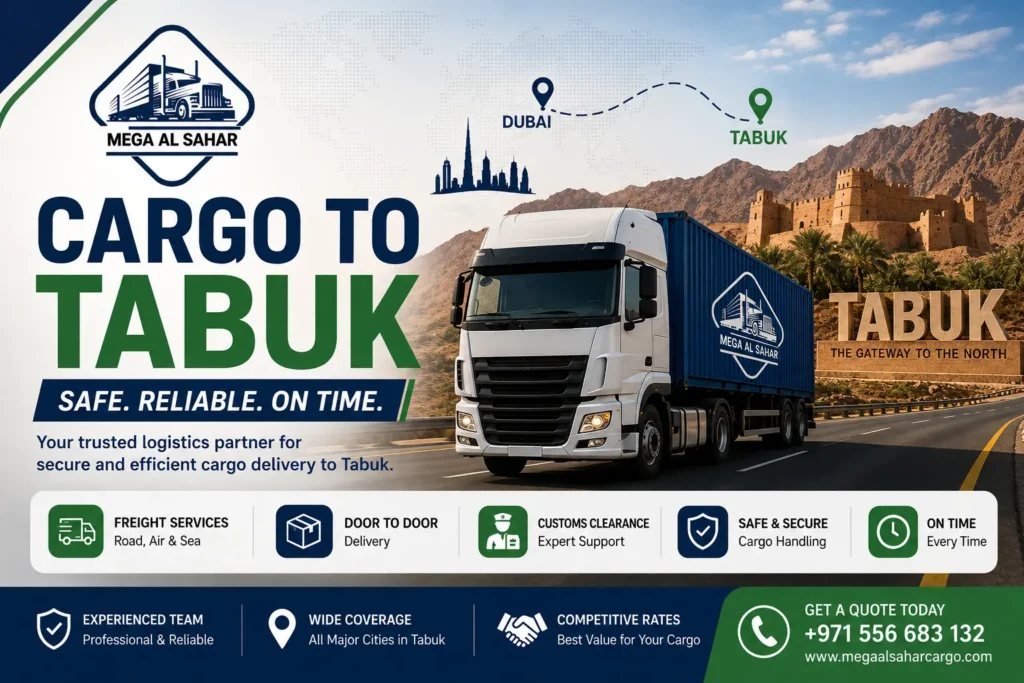
For businesses that need to move heavier or bulkier cargo — machinery, vehicles, furniture, palletised goods, or full container loads — road freight from Dubai to Tabuk is very often the most practical option, both on cost and on flexibility, compared to air freight.
Tabuk city itself sits inland from the Red Sea coast, with the port town of Duba and the border town of Haql nearby along the coastline, and Jordan’s border only a short distance to the north. This geography places Tabuk at a genuine logistics crossroads — close enough to the Red Sea and NEOM’s coastal developments to serve as a supply hub, yet connected south and east to the rest of Saudi Arabia’s highway network, and onward to the UAE. That combination is a large part of why demand for reliable freight to Tabuk has grown steadily rather than in short bursts tied to a single project.