/* Generates expandable FAQ dropdowns directly in Google search results */ /* Signals page authority & surfaces the booking process as a HowTo */

⚠️ Scam Alert: We are not affiliated with any unauthorized individuals or organizations. For verification or inquiries, please contact Mega Al Sahar Cargo directly at +971556683132 or info@megaalsaharcargo.com

Cargo to Najran from Dubai — Road, Air & Pallet Freight Services

Cargo to Najran from Dubai — Road, Air & Pallet Freight Services

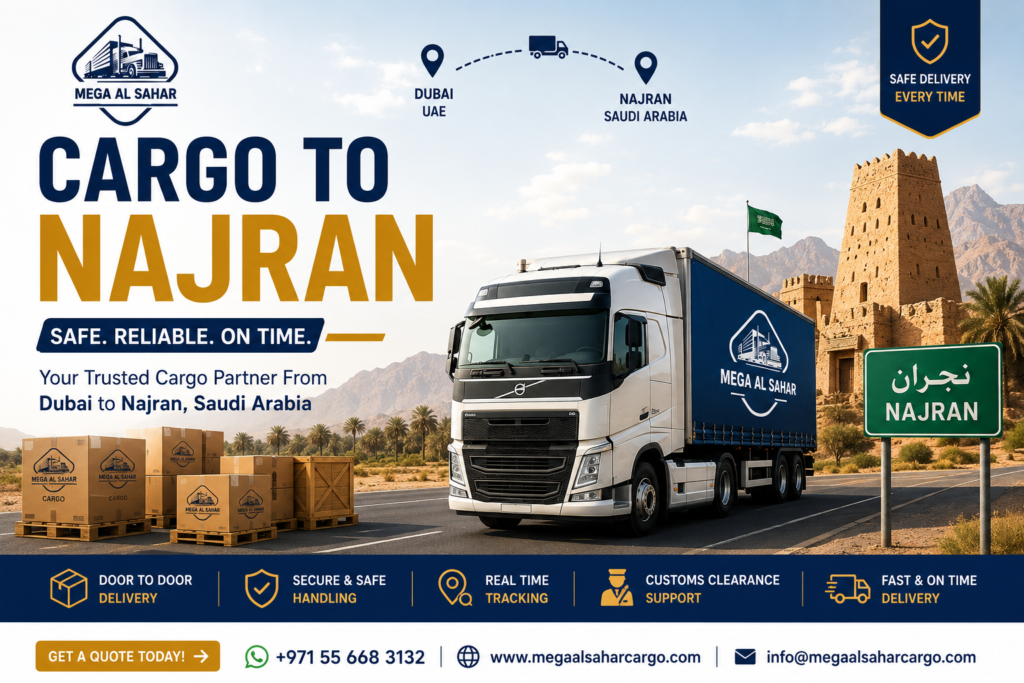
Mega Al Sahar Cargo ships cargo from Dubai to Najran, Saudi Arabia by road freight (FTL/LTL, 3–4 days transit) and by air freight via Najran Regional Airport (EAM), with full customs clearance, SASO/SABER-compliant documentation, and door-to-door delivery for commercial, personal, and palletized cargo.

Najran sits at the far southwestern edge of Saudi Arabia, close to the Yemeni border, which makes it one of the more logistically demanding — and commercially underserved — destinations in the Kingdom. Businesses and individuals moving goods here from the UAE often struggle to find a freight partner that understands both the Dubai export process and the specific customs, road-permit, and last-mile realities of Najran Province. This guide explains exactly how cargo moves from Dubai to Najran, what documentation Saudi customs requires, how long it takes, what it costs, and how Mega Al Sahar Cargo manages the entire route from pickup to delivery.

Cargo to Najran

Najran is the capital of Najran Province in southwestern Saudi Arabia, roughly 800–850 km south of Riyadh and close to the Saudi–Yemen border. Historically a stop on ancient incense trade caravan routes, the city today is a regional hub for agriculture (notably dates, grapes, and pomegranates), light manufacturing, and border trade, alongside a growing government, education, and healthcare sector. Najran is served by Najran Regional Airport (IATA: EAM), which handles both domestic connections to Riyadh, Jeddah, and Dammam through Saudia and flynas, and a direct international route to Dubai operated by flydubai — a detail that matters for shippers, since it means air cargo capacity between the UAE and Najran already exists on scheduled commercial flights, not just charter.

Because Najran is geographically isolated from the UAE’s main logistics corridor (Dubai–Riyadh–Jeddah), most commercial freight into the province moves by road, either as a direct Dubai–Najran haul or consolidated through Riyadh before continuing south. Understanding this distinction — and choosing a freight forwarder who plans for it — is the single biggest factor in whether a shipment to Najran arrives on time and intact.

The province also borders Sharurah to the east, home to its own domestic airport, and stretches toward the Rub’ al Khali (Empty Quarter) desert — a geography that shapes how cargo has to be packed and secured for the final leg of the journey. Local demand is driven heavily by government infrastructure projects, agricultural development around the Najran Dam, and a steadily growing residential and retail sector, all of which rely on imported building materials, equipment, and consumer goods arriving reliably from Gulf trade hubs like Dubai.

Why Businesses Ship Cargo from Dubai to Najran

Dubai remains the primary re-export and sourcing hub for the wider GCC, and Najran-based businesses — construction contractors, agricultural suppliers, retail distributors, and relocating families — regularly source equipment, building materials, consumer goods, and household items from Dubai’s free zones and wholesale markets. Common cargo categories moving on this lane include:

  • Construction materials and hardware for infrastructure and residential projects
  • Retail and FMCG goods for distribution to local markets
  • Agricultural equipment and irrigation supplies
  • Vehicle spare parts and machinery components
  • Household and personal effects for individual and family relocations
  • Palletized commercial cargo for SMEs expanding into southern Saudi Arabia

Because Najran doesn’t have the freight density of Riyadh or Jeddah, many national carriers treat it as a low-priority route with unpredictable transit times. A dedicated forwarder that plans direct trucking capacity to Najran, rather than routing through multiple regional hubs, is what keeps transit times consistent.

Shipping Methods: Road, Air, and Combined Freight

Road Freight (FTL & LTL) — The Primary Method

Road freight is the backbone of the Dubai–Najran cargo lane. Mega Al Sahar Cargo runs both:

  • Full Truckload (FTL): Dedicated trucks for large-volume commercial shipments, construction cargo, and full-container equivalent loads. Recommended when cargo volume exceeds roughly 12–15 CBM or when delivery speed and exclusivity matter.
  • Less-than-Truckload (LTL): Shared truck space for smaller commercial shipments and personal relocations, priced by weight or volume rather than a full truck.

Trucks depart Dubai, cross into Saudi Arabia via the UAE–Saudi land border (typically through the Al Ghuwaifat/Batha crossing), and continue through the Saudi highway network south through Riyadh before making the final leg into Najran Province. This route allows for GCC customs transit procedures that are faster and better established than air freight for bulky or heavy cargo.

Air Freight — For Urgent or High-Value Cargo

For time-critical shipments — spare parts, medical supplies, urgent commercial documents, or high-value goods — air freight via Najran Regional Airport (EAM) is available. Cargo typically routes through Dubai International Airport (DXB) and, depending on capacity and cargo type, either moves on the direct Dubai–Najran commercial route or is transferred through Riyadh (RUH) or Jeddah (JED) for onward domestic connection. Air freight is faster but priced by chargeable weight (the greater of actual or volumetric weight), making it better suited to smaller, urgent, or high-value loads than to bulk commercial cargo.

Combined Sea-and-Road Freight

For large industrial or project cargo originating outside the GCC, sea freight into Jeddah Islamic Port or King Abdulaziz Port in Dammam, followed by road transport to Najran, is often the most cost-effective option. This method suits heavy machinery, bulk raw materials, and non-time-sensitive commercial shipments where cost efficiency outweighs speed.

MethodTypical Transit Time (Dubai to Najran)Best For
Road Freight (FTL/LTL)3–4 daysCommercial cargo, pallets, relocations
Air Freight1–2 daysUrgent, high-value, low-weight cargo
Sea + Road10–18 daysBulk, heavy, non-urgent industrial cargo

Transit times are indicative and vary with customs processing, border conditions, and cargo type.

Route, Distance & Transit Times

The road distance from Dubai to Najran is approximately 1,900–2,000 km, depending on the exact border crossing and highway routing used. A dedicated FTL truck typically completes this route in 3 to 4 days, factoring in Saudi customs clearance at the land border, mandatory driver rest stops under GCC transport regulations, and the final approach into Najran’s city and industrial zones. LTL shipments consolidated with other cargo can take slightly longer, since trucks may make intermediate stops in Riyadh or other hub cities before continuing south.

Delays most commonly arise from incomplete customs documentation rather than the physical drive itself — which is why pre-clearing paperwork before the truck reaches the border is one of the highest-value services a freight forwarder provides on this specific lane.

Customs Clearance & Documentation Requirements

Shipping into Saudi Arabia — including Najran — requires compliance with Saudi customs and regulatory bodies. Key requirements include:

  • Commercial Invoice and Packing List: Detailing goods description, HS codes, quantities, and declared value.
  • Certificate of Origin: Often required to determine applicable duty rates, particularly for goods not originating in the GCC.
  • SASO / SABER Certification: Many regulated product categories (electronics, machinery, toys, cosmetics, building materials) require a Product Certificate of Conformity and Shipment Certificate of Conformity issued through the SABER platform, administered under the Saudi Standards, Metrology and Quality Organization (SASO), before customs will release the cargo.
  • Import Duty and VAT: Saudi Arabia applies a standard import duty (commonly around 5% for most general goods, higher for specific protected categories) plus 15% VAT, both calculated on the customs-assessed value under ZATCA (Zakat, Tax and Customs Authority) regulations.
  • Bill of Lading / Waybill: A road waybill (CMR-equivalent) for truck freight or an air waybill for air cargo, confirming the contract of carriage.
  • Import License (where applicable): Certain regulated goods and commercial importers require a valid Saudi import license or a registered local consignee to receive the shipment.

Because Najran is a border province, cargo may also be subject to additional security screening compared with shipments destined for major central cities — another reason accurate, complete documentation submitted in advance materially reduces delay risk.

Types of Cargo We Handle to Najran

Mega Al Sahar Cargo manages a broad range of cargo types on the Najran route, including:

  • Palletized commercial cargo — shrink-wrapped and strapped pallets for retail, FMCG, and distribution businesses
  • Construction and building materials — for residential and infrastructure projects across Najran Province
  • Household and personal effects — for individuals and families relocating from the UAE
  • Machinery and spare parts — including agricultural and industrial equipment
  • General commercial cargo — dry goods, packaged products, and consumer items
  • Documents and small parcels — via expedited air freight where required

Each cargo type is assessed individually for the correct freight method, packaging standard, and documentation pathway before booking, rather than defaulting every shipment to the same process.

Packaging, Palletization & Cargo Safety Standards

Given the long road transit and border-crossing handling involved in reaching Najran, packaging quality directly affects whether cargo arrives undamaged. Standard practice includes:

  • Palletizing loose cartons onto standard or Euro pallets, secured with shrink wrap and strapping
  • Reinforced crating for fragile, heavy, or irregularly shaped items
  • Weatherproof wrapping for cargo exposed to desert heat and dust during transit and border handling
  • Clear labeling with consignee details, HS codes, and handling instructions in both Arabic and English to avoid customs delays
  • Load securing inside the truck to prevent shifting on long-haul desert highway routes

Proper palletization is not just a handling preference on this route — loosely packed cargo is significantly more likely to be damaged or to face additional inspection delays at the Saudi border.

Freight Cost Factors: What Determines Your Shipping Price

Pricing for cargo to Najran depends on several variables rather than a single flat rate:

  1. Chargeable weight — the greater of actual weight or volumetric weight (length × width × height ÷ dimensional factor)
  2. Freight method — road (FTL/LTL), air, or sea-plus-road
  3. Cargo type and handling requirements — general cargo vs. hazardous, fragile, or temperature-sensitive goods
  4. Customs classification — whether SASO/SABER certification or additional permits are required
  5. Urgency — standard transit vs. expedited delivery
  6. Full truck vs. shared load — FTL costs more per shipment but less per unit at scale; LTL is more economical for smaller volumes

Because Najran is a lower-density destination compared to Riyadh or Jeddah, requesting a quote based on your actual cargo dimensions and delivery timeline — rather than a generic per-kilogram rate — typically produces a more accurate and competitive price.

Common Challenges Shipping to Najran (and How We Solve Them)

Freight forwarders unfamiliar with the route often underestimate three specific challenges on the Dubai–Najran lane:

1. Border documentation gaps. Trucks arriving at the Saudi border without pre-verified SASO/SABER certificates or a complete certificate of origin are frequently held for additional inspection, sometimes for days. We resolve this by preparing and verifying all regulatory documentation in Dubai before the truck departs, not after it reaches the border.

2. Limited return-load density. Because Najran has lower outbound freight volume than Riyadh or Jeddah, trucks that aren’t part of a planned network often sit idle waiting for a return load, which pushes up cost and reduces available capacity for new bookings. Operating on a scheduled route basis, rather than booking each truck ad hoc, keeps both pricing and availability more predictable.

3. Last-mile access in outlying areas. Some delivery addresses in Najran Province — particularly agricultural sites and newer residential developments — fall outside standard courier coverage zones. Coordinating last-mile delivery directly with a local trucking partner, rather than relying on a generic national carrier’s delivery radius, avoids the handoff delays that cause many Najran-bound shipments to stall in the final few kilometers.

Why Choose Mega Al Sahar Cargo for Najran Shipments

Shipping into a border province like Najran rewards a forwarder with direct, hands-on route experience rather than a generalist courier defaulting to a Riyadh-only network. Mega Al Sahar Cargo, based in Ras Al Khor Industrial Area 2, Dubai, structures its Najran service around three principles:

  • Route-specific expertise: Dedicated planning for the Dubai–Riyadh–Najran road corridor, rather than ad-hoc routing that adds unnecessary transit days.
  • End-to-end customs handling: Preparation and pre-clearance of commercial invoices, certificates of origin, and SASO/SABER documentation before the shipment reaches the Saudi border, reducing the most common cause of delay.
  • Door-to-door accountability: A single point of contact from Dubai pickup through Najran delivery, with shipment tracking and support throughout, rather than handing cargo off between multiple uncoordinated carriers.

For businesses moving recurring freight into Najran, or individuals relocating with household goods, this reduces both the administrative burden and the delivery-time uncertainty that typically comes with shipping into a less-frequently served Saudi region.
Frequently Asked Questions

How long does cargo take from Dubai to Najran? Road freight typically takes 3 to 4 days depending on customs processing at the border and cargo consolidation. Air freight is faster, usually 1 to 2 days, but suits smaller or urgent shipments rather than bulk cargo.

What documents are required to ship cargo to Najran? A commercial invoice, packing list, certificate of origin, and — for regulated product categories — a SASO/SABER Certificate of Conformity are generally required, along with the relevant waybill and import documentation for Saudi customs clearance.

Is air freight available directly to Najran? Yes. Najran Regional Airport (EAM) has a direct flydubai route to Dubai, alongside domestic connections to Riyadh, Jeddah, and Dammam, making air freight a viable option for urgent or high-value cargo.

Can I ship household items to Najran for a relocation? Yes. Personal and household relocation shipments are handled as LTL or dedicated road freight, with appropriate packaging and customs documentation for non-commercial goods.

Does Najran require special customs clearance compared to other Saudi cities? Najran’s location near the Saudi–Yemen border can mean additional security screening for certain shipments. Complete, accurate documentation submitted ahead of the truck’s arrival is the most effective way to minimize any resulting delay.

What is the difference between FTL and LTL for Najran shipments? FTL (Full Truckload) dedicates an entire truck to one shipment and suits large-volume cargo. LTL (Less-than-Truckload) shares truck space across multiple shipments and is more cost-effective for smaller loads.

How is shipping cost to Najran calculated? Cost is based on chargeable weight (actual or volumetric, whichever is greater), freight method, cargo type, customs requirements, and delivery urgency, rather than a single flat per-kilogram rate.

Do you offer door-to-door delivery in Najran? Yes. Cargo is delivered directly to the consignee’s address within Najran city and surrounding areas of Najran Province, rather than requiring pickup from a regional depot.

Can I track my shipment while it’s in transit to Najran? Yes. Shipments are tracked from Dubai departure through Saudi border clearance to final delivery, with status updates available from your assigned logistics contact throughout the journey.

What’s the minimum shipment size for cargo to Najran? There’s no strict minimum — small LTL shipments and single pallets are consolidated with other cargo on scheduled trucks, while larger volumes qualify for dedicated FTL service. Get in touch with your cargo dimensions for the most accurate option.

Get a Quote for Your Najran Shipment

Whether you’re moving palletized commercial cargo, construction materials, or household belongings, Mega Al Sahar Cargo manages the full Dubai-to-Najran process — pickup, road or air freight, Saudi customs clearance, and final delivery — from a single point of contact. Contact our team for a shipment-specific quote based on your cargo’s weight, volume, and delivery timeline.

Mega Al Sahar Cargo 📍 Ras Al Khor Industrial Area 2, Dubai, UAE ☎️ +971 55 668 3132

Provide perfect one-stop Cargo services for customers in Saudi Arabia, UAE, Kuwait, Qatar, Oman and Bahrain.

Contact Info

© 2026 Mega Al Sahar Cargo

+971556683132